Thursday, 10 February 2011

Papers and Peer Pressure

by Susie Burdett

I had thought that I would blog to celebrate the creation of UN Women, the new UN organisation that has taken over operations for gender equality from the previous four organisations of the UN that were once dedicated to women's issues. I was going to talk about some projects, such as Prosperity Candles, or a shelter in Ethiopia, that are some of the positive initiatives occuring in complex political contexts. But then this article, about toilets, worked to combine a few of the random loose threads circling my brain.

Those loose threads can be effectively summed up in the picture at the top of this article.

So how do I get from toilets to Julia Roberts? Well, simple really. The International Development Enterprises (IDE) are trying to improve sanitary conditions in Cambodia and at the same time provide economic opportunities for local businesses. They do this through the somewhat controverisal method of shaming people into using a toilet. Sanitary conditions are a major problem in Cambodia. For the sake of those of a more sensitive constitution, I won't go into detail, but previous attempts to improve conditions by giving toilets away have failed. By shaming people into wanting a toilet, the IDE hopes to create the motivation to use it, and having developed an easy to build model, they have given local businesses a chance to build and sell the toilets, thus increasing economic activities at the same time as improving living conditions.

On the other hand is a photo of Julia Roberts dressed to impress which was widely ridiculed in the press due to the naturally occuring axillary hair clearly on display. Media, whether that be the newspapers, movie (both mainstream and x-rated) makers or magazines, continuely subjected people to images of a a supposed ideal of man and womanhood. Media has helped make plucking, shaving, trimming and shaping of body hair the norm, and have transformed plastic surgery to an aspiration for many seeking this apparent model of perfection, rather than a valuable tool allowing those suffering terrible injuries and disfigurements to lead normal lives.

Whilst I may find a narrow definition of beauty - and indeed the stress on the importance of beauty over other, more practical virtues - uncomfortable and distasteful, I am not actually condemning the beauty industry or the media (and cultural) obsession with celebrity and beauty - I am in no position to cast the first stone. My point is, if media can change the beauty ideal from the hairy men and women found in, say, The Joy of Sex to the plucked, buffed and toned actors, actresses and models we see on film, TV and in magazines, what else could they do?

Media, particularly social media, has been vital to raising awareness of conflict and tragedies around the world - as has been clearly highlighted by the news coming from Tunisia and Egypt, but it has also used peer pressure and shame to inflict and impose a narrow view of gender. It is clear how powerful media is as a force for creating change and raising awareness. How much change could they do for the good if, rather than using shame to inflict one way of being a woman (or man), they celebrated humanity, condemned injustice and encouraged equality? Both the media and the IDE use shame in their tool kit. But what a difference in the results!

Tuesday, 1 February 2011

A Note to Men

by Richard McAdam


Gentlemen.

Is for you the word 'feminism' burdened with negative connotations? Does it foster in your manly breast prejudice and resentment, and elicit little more from you than a cocky rolling of the eyes and the arching of an insouciant brow? Does it conjure up images of angry, shrill lesbians daring to express outrage at invisible injustices? Then let me, as one man to another, prescribe the following course of action: through rigorous self-examination, self-education and self-flagellation, you resolve to STOP BEING AN IDIOT, and with the aid of some sort of neuro-linguistic programming adopt a deep and irrefutable notion that the above reactions to the f-word are clear and present symptoms of your BEING AN IDIOT. YOU IDIOT.

What this does not mean: adopting 'feminist' views as a means-to-an-end, paying lip service in order to get some 'lip service' ifyouknowwhatImean. (I mean kissing). It does not mean merely affecting outrage at the objectification or oppression of women when you are not possessed of any true and tangible notion of what that actually means, on any real and visceral level. It does not mean insisting on workplace equality and settling for that as being the only kind of equality that is important. It does NOT mean spouting hollow homilies on the strength and individuality of women or the beauty of the female form whilst at the same time clinging to an idea of them as possessions, convenient accessories for your ego. Don't kid yourself that the men who inflict the horrific physical and emotional violence in the stories from distant lands are some sort of different species, 'monsters' completely alien to your idea of yourself. We might not all necessarily be nurturing the capacity for that sort of cruelty; but that sort of cruelty has been born of these sorts of attitudes.


Why does it not mean these things? Because, ultimately, it's you, as a man, being oppressed; it's you, as a man, suffering the inequality and the prejudice. Not as a result of some numinous notion of human 'togetherness', but because this attitude directly diminishes you. You are a victim of your own discrimination, because what you excise when you decide that you will view women as anything other than equal is a fundamental function of your self. And no, you are not destroying your 'feminine spirit' – you are destroying your 'masculine spirit'. You just need to adjust your idea of what 'masculine' means.

Let me offer you up a contemporary role model: the motion-picture actor Ryan Gosling. Here at Mr. Hugo Schwyzer's blog (a site I'd recommend you delve deep into as part of your self-education), Mr. Schwyzer suggests Mr. Gosling's characterisations as presenting 'a new kind of masculine ideal', because 'he plays flawed and complex men whose tender decency is always at war with his compulsions and his rage,' and not 'overgrown boys'.

The skills needed to fight that war, and to achieve the goals of altering/enhancing/maintain your attitudes toward women are conveniently concomitant with the skills required to be fulfilled and happy. (Or the act of striving to cultivate those skills is in itself fulfillment and happiness, probably, or something.) They are the skills that will, ultimately, make the world a better place. Responsibility, kindness, maturity, and a balance of stoicism and sensitivity. These shall be your goals and your rewards.

Also, girls will like you more, you idiots.

Tuesday, 11 January 2011

Dates and Women

No, this blog isn't about the effects of a sticky fruit on women, or a guide to how best to romance a potential date, but is a kind of follow up to my last post International Day for the Elimination of Violence against Women. The article "Dates and Women" on the BBC website was sent to me as possible inspiration for a blog post, and it seemed a suitable subject as a follow up. I encourage any and all readers of this blog to take a peek, if only to save me having to regurgitate the whole argument!

Farai Sevenzo writes a passionate and meaningful article about the need to go beyond dedicating days to women, and to look to making marked attidudinal changes to women's position, status and education. He argues that whilst dedicating days to raising awareness of women's issues is a start, we have to make changes in our own outlooks, and to bring about real differences, promote change and go further than the odd flashpoint of interest.

Whilst I agree with much of what Mr Sevenzo says, what strikes me most about the article are the comments left by readers at the bottom of the article. I feel that these highlight how our own points of view affect how we interpret the world. Among the comments left is praise from a Social Scientist, glad to shaken out of theoretical inertia and many comments from women from all over Africa speaking in support of dedicating dates to the issues they, and their sisters across the world face. But I think that two comments in particular jump out at me, one from an African woman who seems a little defensive, criticising Mr Sevenzo for discussing days dedicated to women, rather than commenting on the number of other days dedicated to other causes. She expresses no surprise that the article is written by a man. The last post (or at least at the time of writing this blog) comes from an British woman, who expresses her thanks that an African man points out the need for change, and for a new approach to the ending of gender discrimination.

I think these two posts in particular highlight the difference a persons perceptions can have on how they read this article - on one hand a lady who feels aggreved that a man should suggest that days dedicated to womens causes are not final solution to gender discrimination, and on the other hand we have a lady who agrees that we need to change our attitudes and awareness, not just on one or two important dates, but in general. The way we feel about an issue, and about the wider world, can affect how we view a certain situation. I am no exception to this. Doubtless I have read the post in a different way in which you may have done. This is what I get out of this story. Until we look critically at how we view the world, question our own assumptions, learn, educate others and fight inertia in the face of discrimination, real change will not happen, no matter how many Women's days there are. Last year was the centenary of the International Day to Eliminate Violence Against Women. Lets hope that by next anniversary there has been some real, positive change in the value women are held in, a reduction in discrimination and violence against women, and an improvement in their education.

Tuesday, 23 November 2010

International Day for the Elimination of Violence against Women

By Susie Burdett

The United Nations has declared the 25th November as the International Day for the Elimination of Violence against Women, and marks the beginning of the 16 days of Activism Against Gender Violence Campaign. Which seems as good a time to blog as any!


But the difficulty is what to blog about. I could talk about the abuse women suffer at the hands of those at home, by strangers, and even, in some places, by the authorities. I could discuss the use of such cruel punishments as flogging and the death penalty (or even just the death penalty itself). The choice is (sadly) almost endless, but I think I’m going to take inspiration from the root of the day, and see where it takes me…


The 25th November isn’t just a random date chosen from the 365 available, but is the anniversary of the assassination of the Mirabal Sisters. Patria, Minerva and Maria Teresa were three sisters (their fourth sister is still alive and curates a museum dedicated to them) heavily involved in the resistance against the Dominican dictator Rafael Trujillo, who ordered their assassination. On the 25th November, after a visit to their husbands in prison, the three sisters, plus their driver, were dragged into a sugar cane grove then beaten and strangled to death. This marked the beginning of the end for Trujillo, who was assassinated a year later.


The Mirabal Sisters are just some of the many female political campaigners who dedicate their lives, sometimes at great danger to themselves, to promote democracy, equality or justice. Women all over the world, in many different ways, have, do and will continue to fight for what they see as right. From the Suffragettes of late 19th/early 20th Century Britain, to women participants in collective action in the South America, Asia and Africa, women have and do fight to promote democracy.


Political participation, however, continues to be problematic for the female sex. Women who wish to actively participate in politics continue to face challenges and obstacles, even when they have gained the right to vote and to stand in government. In Afghanistan, for instance, female candidates face intimidation and often violence during their campaigns. For one candidate, this intimidation ended in tragedy when five of her campaigners (all male) were killed.


Even in countries with a longer history of equal participation, such as the US, women candidates face obstacles in their campaign. This article shows how news media in the US treat male and female candidates differently. Female candidates not only receive less coverage, but their coverage concentrates more on their viability as candidates than their issue positions, and to further compound their chances, their viability coverage is more negative than their male counterparts (for instance, we are likely to be able to say more about the likelihood of Christine O’Donnell being a witch than on her political beliefs). With this kind of coverage, the general public, who are often dependent of the news media for their information on candidates, are more likely to form a negative opinion of female candidates than their male opponents.


But let us be more positive for a moment. Where there is success for female activists, and there are many successes, the benefit isn’t just to them, or just to women, but to the whole of their communities, country and to the wider world, who in today’s global communication era are touched by the efforts of others. This week we have also seen the release of Aung San Suu Kyi, whose decades long campaign to bring democracy to Burma, which has come at such a huge personal cost, has brought international attention to the plight of the Burmese people, and whose release will hopefully bring fresh hope to the people of Burma.


I realise that I have strayed from the theme of eliminating violence against women, but I firmly believe that without democratic privileges, women will not be free from violence, as they will not be able to hold to account the people who perpetrate that violence without the mechanisms which democracy gives them. Democracy is also an appropriate subject, as for many prominent female political campaigners (as well as make campaigners), violence and aggression are common tools employed to silence them.


I have always said that I will cast a vote at every opportunity given to me, because people have fought to give me that right and people continue to fight for that right, facing intimidation, aggression and violence. Voting is a privilege I am lucky to have, and with privilege comes responsibility.


Wednesday, 25 August 2010

Man Up

by Emily Oldrieve

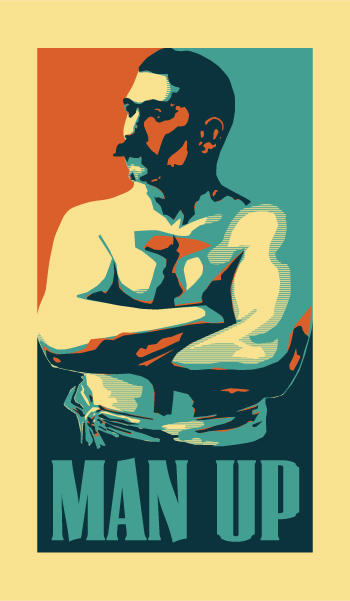
Recently, whilst queueing in a popular coffee shop, I overheard a conversation between two female friends which included the phrase: ‘that girl needs to man up’. At the time I took little notice of this as my concentration was fully engaged in obtained a much needed caffeine hit; however, in retrospect, I feel this statement needs some consideration, especially in terms of gender equality. On examining the episode it struck me that, perhaps more bizarre than the glaring contradiction expressed, was the fact that I did not immediately identify the statement as a contradiction. It seems that loaded phrases such as these have become common colloquialisms, at least for certain sections of modern British society. The two main points I want to consider are how important it is, in the grand scheme of things, to take the time to worry about something as abstract as a throw-away comment made in casual conversation. Furthermore to then understand what exactly the connotations of the phrase ‘man up’ actually are.

To address my first point, I must admit that I did initially feel my topic might be fairly insignificant when I read through previous blogs on this website which contain heart-wrenching stories, and facts that paint a scary picture for gender equality across the globe. Obviously what I am talking about isn’t the difference between life and death; however I feel we must not forget the seemingly little things which can, sometimes, make us aware of inequalities embedded in our society. Although words in themselves cannot be compared to an immediate, physical threat it is the vast amount of social and historical implications behind a phrase that represents the danger. To clarify this, I came across a rather interesting radio program hosted by Stephen Fry for the BBC entitled He Said, She Said (available on BBC i-player). Although he is exploring a slightly different issue he does discuss how during the 1970-80s women campaigned against words such as ‘chairman‘ claiming it should be ‘chairperson’, and ‘humankind‘ instead of ‘mankind‘. A significant part of their campaign was aimed at an awareness that certain words are unfairly orientated, in this case towards men. The importance of changing words and phrases for these women lay in the fact that words are heavily loaded with social meaning that every member of that society understands albeit subconsciously. I am not suggesting that we should be saying ‘person up’ or exiling gender based phrases from our vocabulary, but i am emphasising the importance behind words and the role they have in maintaining or establishing gender inequalities, and that we should be aware of what we are saying if we are to use these phrases.

So, what exactly are we saying? The phrase ‘man up’ as I understand it means that one should either stop being overly sensitive, be brave or take responsibility. Does this therefore mean that only men can possess these qualities, and for women to become less sensitive or braver they must become more masculine? Can there not be a un-sensitive or a brave female personality? Similarly if this phrase is implying that a man is un-sensitive and hardened does this mean that all males must display these characteristics to be classed as a ‘man’? Furthermore is it suggesting men should be more obligated than women to live up to these characteristics? Any or none of these interpretations could be valid, but if these are the insinuations that lie behind a seemingly harmless comment it is an example of the dangerous and old fashioned stereotypes still being kept alive implicitly behind everything we say. Essentially this phrase relies upon, and supports, unhelpful generalisations about gender and detract from positive changes that are being attempted in our society in general. If nothing else this goes to highlight how issues of equality can affect every facet of our lives, and we should be aware of attacking inequality from every angle: even when we are gossiping in coffee shops!

Monday, 16 August 2010

The Way We Were

by Emma Holden

Today, in England, gender inequality is still obvious. We like to think that we live in an equal country; with the rights of women prioritised. But wherever we go, we still see forms of discrimination. A woman earns 66 pence for every £1 a man earns in the same job. How is this fair? The onus of childcare is still very much on women, although through the recent recession, we have seen an increase in fathers staying at home, taking the role of a ‘yummy daddy’ whist the wife goes out to work. This has also caused a problem, with many mothers regarding fathers in the playground as suspicious, because it is so different from the traditional norm. There is the misconception; because of media attention of paedophilia, that men looking after children is not ‘PC’. It’s the tradition that women should look after the children. We need to stop thinking one gender is superior to the other. But it’s not as simple as that. Much of Europe has come a long way in changing chauvinist delusion, but this has taken time. We cannot change cultures and traditions by just snapping our fingers. It takes time and knowledge.

We challenge the way Britain views women, but we challenge a situation that has improved dramatically over past generations. We fail to remember that our society is so developed. Maybe our expectations are too high. But everyone should demand and receive equal rights. Nowhere should it be practiced that men have rights over women. We English…We’re the lucky ones, aren’t we? Those conscientious of us worried about the inequalities within gender relations should look abroad to the unlucky ones, where to give birth to a baby girl is viewed as distasteful and is a hindrance. Many mothers choose to end the life of her daughter in sex selective abortions, particularly common in India, so the unborn baby girl would not have to suffer a life of coercion, physical abuse and confinement.

Instead of growing up with their parents telling them “they can be who they want to be”, young girls in many developing countries fight the continual battle of servitude and are subjected to physical and mental abuse from a very early age of 9 or 10.

It is accepted in Britain that woman should have the liberty to divorce an abusive husband, publicly flirt or choose her own husband. But why is it that in some cultures the opposite is the case? Women bear most of the responsibility for her family and produce half of the world’s food, yet are denied access to resources they need to satisfy this burden. Two thirds of the world’s illiterate and the vast majority of the world’s poor are women. In many developing countries, if the actions of a woman should dishonour her family she would be disciplined to honour her family’s reputation. This often means the execution of an innocent woman for standing out against chauvinist traditions. In Pakistan, three of these ‘honour killings’ take place a day, including victims of rape.

Tradition calls for women to eat last, and are often reduced to picking over the leftovers from the men and boys. The current world food price crisis has caused devastating problems with malnutrition of women and children. Women are often denying themselves their one meal a day to ensure their children are fed. As long as girls and women are treated as inferior and less valuable than boys, malnutrition will remain high and countries such as Bangladesh will suffer impaired economic growth as a result.

The core of poverty and chauvinism rises from the misuse of power within countries and communities. Women who have an education are more likely to survive a child’s birth, get married later and have a better job, as well as protect themselves from HIV/AIDS. All over the world girls are denied an education, and are destined to a life of serfdom. In some parts of India, it is traditional to greet a family with a newborn girl by saying, "The servant of your household has been born." We need to change this. With an education a woman can gain a higher status within her community. This status translates as power to influence families and friends. Women can only speak out against their livelihoods if they have the education and thus confidence to do so. In England in 1918, the Representation of the People’s Act was passed which marked the beginning of female suffrage in Britain. The educated suffragettes had a large part in this. With more education the future of the world will change, and it will change for the better. An educated woman is a confident woman. When we women come together we can work miracles. Let’s stop gender inequality. Let’s educate the masses.

Saturday, 14 August 2010

Embrace your Inner Girl

by Stephanie Hubbard

I was doing a bit of casual Internet surfing the other day when I came across this blog post by Jaqueline Campbell about feminism and femininity. Her post 'My Right to be a Feminist' features on the MTV Staying Alive campaign website as part of their 'Right to be Me' season.

Jaqueline's post is inspiring as she strives to dispel the myths around feminism and expresses that to be a feminist is not a declaration of hatred for all things male nor is it a rejection of female sexuality. She defines her concept of feminism in her powerful parting statement:

'Feminism is my right to say that painting my nails red and studying physics are not mutually exclusive.'

Her post reminded me of a powerful speech given by Eve Ensler, writer of the Vagina Monologues and founder of V Day. Her speech for TED Talks discusses the presence of the 'girl cell' in all of us that we have been taught to suppress.

'I want you to imagine that this girl cell is compassion, and it's empathy, and it's passion itself, and it's vulnerability, and it's openness and it's intensity and it's association, and it's relationship, and it is intuitive.

And then let's think how compassion informs wisdom, and that vulnerability is our greatest strength, and that emotions have inherent logic, which lead to radical, appropriate, saving action. And then let's remember that we've been taught the exact opposite by the powers that be, that compassion clouds your thinking, that it gets in the way, that vulnerability is weakness, that emotions are not to be trusted, and you're not supposed to take things personally, which is one of my favorites.

I think the whole world has essentially been brought up not to be a girl.'


She goes on to share terrible stories of genital mutilation, rape and abuse endured by women the world over. She exposes how much the world degrades, marginalises, tortures and humiliates girls and how little value is placed in them.

'I've seen that we cut girls and we control them and we keep them illiterate, or we make them feel bad about being too smart. We silence them. We make them feel guilty for being smart. We get them to behave, to tone it down, not to be too intense. We sell them, we kill them as embryos. We enslave them. We rape them. We are so accustomed to robbing girls of the subject of being the subjects of their lives that we have now actually objectified them and turned them into commodities.'

Powerful words indeed. Eve also argues that men have a right to embrace their 'girl cell' and suggests that this culture of teaching our boys to suppress emotions of compassion, vulnerability and empathy is the root cause of some of society's biggest problems.

Eve's passionate speech calls us to recognise that to be a girl is not to be weak. Being a girl is to be a powerful, resilient and resourceful being. To be a girl is to be 'an emotional creature' and Eve's piece at the end of her speech is a powerful call to empowerment for everyone with an inner 'girl cell'.


Jaqueline is exercising her right to be a girl and so should we all.