Recently, whilst queueing in a popular coffee shop, I overheard a conversation between two female friends which included the phrase: ‘that girl needs to man up’. At the time I took little notice of this as my concentration was fully engaged in obtained a much needed caffeine hit; however, in retrospect, I feel this statement needs some consideration, especially in terms of gender equality. On examining the episode it struck me that, perhaps more bizarre than the glaring contradiction expressed, was the fact that I did not immediately identify the statement as a contradiction. It seems that loaded phrases such as these have become common colloquialisms, at least for certain sections of modern British society. The two main points I want to consider are how important it is, in the grand scheme of things, to take the time to worry about something as abstract as a throw-away comment made in casual conversation. Furthermore to then understand what exactly the connotations of the phrase ‘man up’ actually are.

To address my first point, I must admit that I did initially feel my topic might be fairly insignificant when I read through previous blogs on this website which contain heart-wrenching stories, and facts that paint a scary picture for gender equality across the globe. Obviously what I am talking about isn’t the difference between life and death; however I feel we must not forget the seemingly little things which can, sometimes, make us aware of inequalities embedded in our society. Although words in themselves cannot be compared to an immediate, physical threat it is the vast amount of social and historical implications behind a phrase that represents the danger. To clarify this, I came across a rather interesting radio program hosted by Stephen Fry for the BBC entitled He Said, She Said (available on BBC i-player). Although he is exploring a slightly different issue he does discuss how during the 1970-80s women campaigned against words such as ‘chairman‘ claiming it should be ‘chairperson’, and ‘humankind‘ instead of ‘mankind‘. A significant part of their campaign was aimed at an awareness that certain words are unfairly orientated, in this case towards men. The importance of changing words and phrases for these women lay in the fact that words are heavily loaded with social meaning that every member of that society understands albeit subconsciously. I am not suggesting that we should be saying ‘person up’ or exiling gender based phrases from our vocabulary, but i am emphasising the importance behind words and the role they have in maintaining or establishing gender inequalities, and that we should be aware of what we are saying if we are to use these phrases.
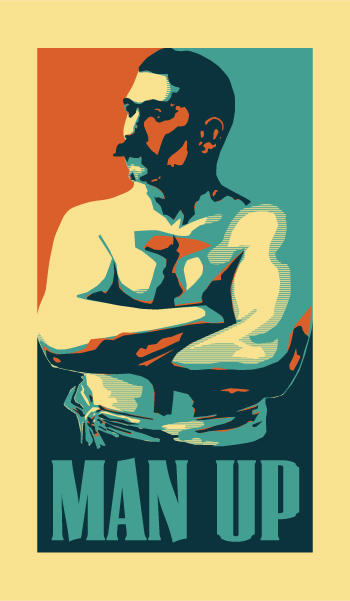
So, what exactly are we saying? The phrase ‘man up’ as I understand it means that one should either stop being overly sensitive, be brave or take responsibility. Does this therefore mean that only men can possess these qualities, and for women to become less sensitive or braver they must become more masculine? Can there not be a un-sensitive or a brave female personality? Similarly if this phrase is implying that a man is un-sensitive and hardened does this mean that all males must display these characteristics to be classed as a ‘man’? Furthermore is it suggesting men should be more obligated than women to live up to these characteristics? Any or none of these interpretations could be valid, but if these are the insinuations that lie behind a seemingly harmless comment it is an example of the dangerous and old fashioned stereotypes still being kept alive implicitly behind everything we say. Essentially this phrase relies upon, and supports, unhelpful generalisations about gender and detract from positive changes that are being attempted in our society in general. If nothing else this goes to highlight how issues of equality can affect every facet of our lives, and we should be aware of attacking inequality from every angle: even when we are gossiping in coffee shops!
To address my first point, I must admit that I did initially feel my topic might be fairly insignificant when I read through previous blogs on this website which contain heart-wrenching stories, and facts that paint a scary picture for gender equality across the globe. Obviously what I am talking about isn’t the difference between life and death; however I feel we must not forget the seemingly little things which can, sometimes, make us aware of inequalities embedded in our society. Although words in themselves cannot be compared to an immediate, physical threat it is the vast amount of social and historical implications behind a phrase that represents the danger. To clarify this, I came across a rather interesting radio program hosted by Stephen Fry for the BBC entitled He Said, She Said (available on BBC i-player). Although he is exploring a slightly different issue he does discuss how during the 1970-80s women campaigned against words such as ‘chairman‘ claiming it should be ‘chairperson’, and ‘humankind‘ instead of ‘mankind‘. A significant part of their campaign was aimed at an awareness that certain words are unfairly orientated, in this case towards men. The importance of changing words and phrases for these women lay in the fact that words are heavily loaded with social meaning that every member of that society understands albeit subconsciously. I am not suggesting that we should be saying ‘person up’ or exiling gender based phrases from our vocabulary, but i am emphasising the importance behind words and the role they have in maintaining or establishing gender inequalities, and that we should be aware of what we are saying if we are to use these phrases.
So, what exactly are we saying? The phrase ‘man up’ as I understand it means that one should either stop being overly sensitive, be brave or take responsibility. Does this therefore mean that only men can possess these qualities, and for women to become less sensitive or braver they must become more masculine? Can there not be a un-sensitive or a brave female personality? Similarly if this phrase is implying that a man is un-sensitive and hardened does this mean that all males must display these characteristics to be classed as a ‘man’? Furthermore is it suggesting men should be more obligated than women to live up to these characteristics? Any or none of these interpretations could be valid, but if these are the insinuations that lie behind a seemingly harmless comment it is an example of the dangerous and old fashioned stereotypes still being kept alive implicitly behind everything we say. Essentially this phrase relies upon, and supports, unhelpful generalisations about gender and detract from positive changes that are being attempted in our society in general. If nothing else this goes to highlight how issues of equality can affect every facet of our lives, and we should be aware of attacking inequality from every angle: even when we are gossiping in coffee shops!
